

If you’ve ever purchased used film equipment on eBay, you’ve found that most results are from sellers in Japan — from large, established, Tokyo retailers like Map Camera, or from lower volume shops in smaller towns.
It makes sense, of course, because most of these cameras from brands like Canon and Nikon originated there. Walking the streets of neighborhoods like Shinjuku in Tokyo, you’ll find exceptional stock and quality at good prices that you simply can’t find anywhere else.
Unfortunately, that experience no longer translates to shopping on eBay in the way it used to.
The New Reality
It’s impossible to escape the new Trump-era tariffs. Regardless of the politics, if you import from Japan, you will pay.
eBay was once a safe haven from tariffs thanks to the de minimis rule. That stopped, though, thanks to an executive order that went into effect at the end of August, 2025.
Now, all packages are subject to tariffs — including Trump’s new supplementary rules that apply to all purchases regardless of category — even if they are under the previous $800 threshold.
Unsurprisingly, this caused a good bit of confusion on eBay listings. eBay started posting warning messages telling buyers they might be responsible for duties on their purchase. Sellers weren’t especially quick to update their listings, and I observed many relying on the guidance from eBay’s warnings.
Now, you’ll find what’s arguably worse.
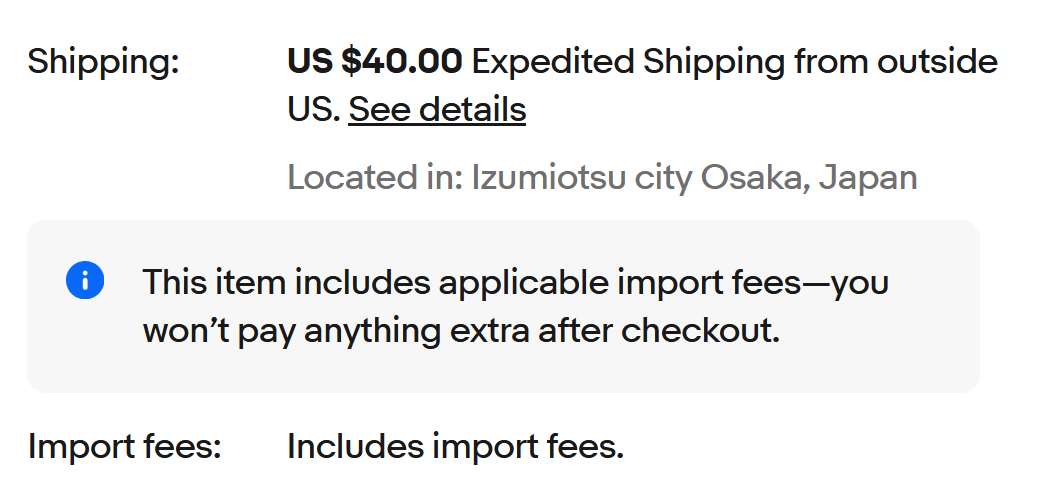
eBay has done away with most of their warnings. Instead, they’ve been replaced with the language of “This item includes applicable import fees—you won’t pay anything extra after checkout.”
That sounds reassuring, but it is often false. In fact, on just the second listing (for a Nikon FM3A) I clicked while writing this article, the contradiction was apparent. eBay’s UI claimed duties were covered; the seller’s description explicitly stated they were not:
Further down:

Is this malice or just a broken system? I’m not sure if eBay explains this clearly to sellers, or if sellers are ignoring it to keep prices looking competitive. After all, honesty is expensive: on a $900 camera, the tariff is roughly $135.
That single charge is often enough to erase the savings you expected when buying from a Japanese seller in the past, bringing the final cost on par with a domestic purchase that doesn’t require a duty.
Crucially, these fees aren’t collected at checkout. You get hit with the bill when the package is out for delivery, or possibly weeks later, when you have likely forgotten about the possibility. This creates a nightmare scenario: you pay hundreds of dollars in non-refundable duties before you even inspect the camera. If you have to return the item, you do not get that tax money back. FedEx and DHL will also get their share with “processing” and “admin” fees, all non-refundable.
That might sound unfair, but it’s just the reality. FedEx and DHL are acting as the broker. When a package comes through customs and requires payment, they are making the payment for you with the expectation you will reimburse them. The seller has nothing to do with that transaction — it’s entirely between you and the shipping company.
If you decide you’re not going to pay it, they may fail to deliver the package and will almost certainly send a collections agency after you.
The whole system feels designed to be confusing. It’s hard to get straight answers, and no one is able to say, “You’ll be required to pay this much.” Sellers aren’t willing to take that responsibility, and searching for answers on forums leaves you with responses ranging from “I didn’t have to pay anything” to “I had to pay a $1000 fee!”
Do not rely on AI chatbots like ChatGPT for clarity, either. The regulations have shifted so aggressively in late 2025 that the training data simply hasn’t kept up. You are flying blind.
In my experience, many Japanese sellers are proactive, messaging me before shipping to confirm I understand the expectation of a duty payment. They are generally good actors stuck in a bad system. However, a buyer cannot rely on a seller’s goodwill. You must read the description in full. Until eBay fixes its interface, their ‘Import Fees Included’ badge is worse than useless—it’s a trap.
Effect on the Market
The Trump administration’s broad response to criticism on tariffs is that companies and consumers should simply “suck it up”. While that might work for retailers that can absorb a hit to their margins by having fewer discounts or reducing costs elsewhere, it doesn’t apply to small Japanese camera stores.
This is a used market composed of individual shops trying to scrape some margins off equipment that’s decades old — not a manufacturing supply chain.
Some listings do try to hide the pain. You will see items with “free shipping” where the duty is baked into a higher list price, or conversely, lower list prices with exorbitant $150 shipping fees to cover the difference. In comparison, the FM3A listing I mentioned earlier carried a $40 shipping fee — a rate that would have been mostly acceptable before the new tariffs.
But no matter how you slice it, the consumer is footing the bill for a tax on equipment that hasn’t been manufactured in decades.
Theoretically, the goal of these tariffs is to incentivize business with American companies. But for film photographers, that alternative is largely a mirage. The domestic stock simply isn’t there.
Take my recent purchase of a Mamiya RB67 as an example. I bought a “Mint” condition kit from Japan for $402. Even after paying $73 in duties and fees to DHL, the total came to roughly $475. Upon inspection, the camera was pristine; it only needed new light seals, which was a cheap and easy DIY fix.
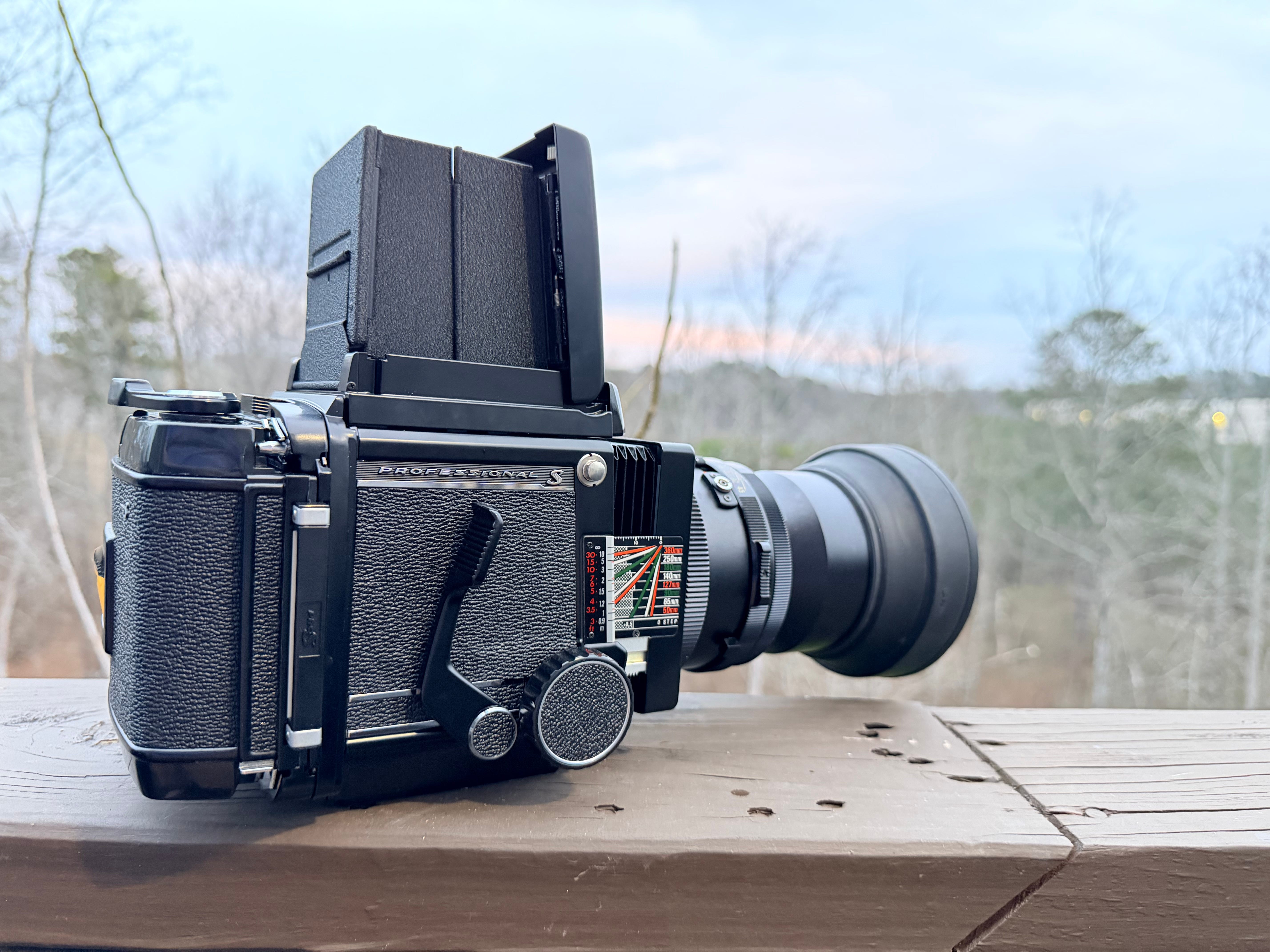
Compare that to the American market. Listings for the same camera on eBay US are scarce and often in rough shape, requiring repairs far more complex than a light seal swap. Reputable sites like KEH struggle to compete on value. As of this writing, an “Excellent” graded body costs $251, yet that price doesn’t include a waist-level viewfinder — an item they don’t currently even have in stock but was included with mine.
By the time you piece together a working kit from American sellers, you are often paying the same total price for gear that is in significantly worse condition.
Because of this, I highly doubt buyers will rush to purchase lower-grade American stock just to avoid a tariff. The economics don’t make sense.
And, to make matters worse, instead of domestic prices staying low, American retailers have little reason to keep their prices steady. Why would they see the inflated import prices and not adjust their own pricing upward to match the new market floor?
The unfortunate reality for film photographers is that there is no “winning” this trade war. We are simply going to have to accept a new, expensive premium on an already expensive hobby.